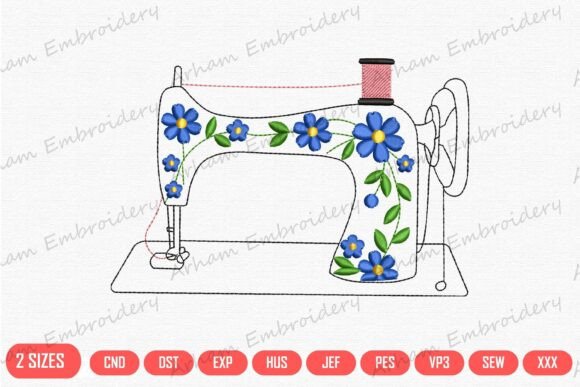
Vintage Floral Sewing Machine
A Thoughtful Review for Small Business Merch & Branded Patches
As an embroidery designer who’s digitized and stitched thousands of designs for small businesses—from neighborhood bakeries to indie florists and handmade studios—I approach every new machine embroidery design with two questions: “Does it tell a story my client’s customers will recognize?” and “Will it hold up, stitch after stitch, on real-world merchandise?” The Vintage Floral Sewing Machine immediately stood out—not as mere decoration, but as a quiet ambassador for craft-led brands. Its title alone evokes warmth, tradition, and tactile creativity—exactly the tone many small business owners seek when building authentic brand identity.
First Impression: Classic Charm with Clear Commercial Intent
The Vintage Floral Sewing Machine feels intentionally elegant yet approachable. It’s not overly ornate or cartoonish—it avoids looking dated or gimmicky. Instead, it lands in that sweet spot between vintage charm and modern clarity: clean lines, balanced floral accents, and a central sewing machine motif that reads instantly—even at a glance. For a café embroidering aprons, a florist branding tote bags, or a craft studio labeling handmade product packaging, this design doesn’t shout; it invites. It signals care, continuity, and hands-on skill—qualities that build customer trust and reinforce perceived product value.
Real-World Performance Across Merch Categories
I tested the Vintage Floral Sewing Machine across several high-impact applications common in small business merch:
- Embroidered patches: Works beautifully as a 2.5”–3.5” woven or embroidered patch—ideal for attaching to denim jackets, canvas totes, or staff uniforms. The floral elements provide visual texture without overwhelming detail.
- Apron embroidery: Placed just above the pocket or centered on the chest, it adds artisanal credibility without competing with functional fabric weight or seams.
- Cap embroidery: At 2” wide, it scales cleanly on front panels. The balanced proportions prevent distortion on curved surfaces—critical for consistent cap embroidery.
- Tote bag design: On natural cotton or canvas, it reads clearly even from three feet away. Its moderate stitch density prevents stiffness while retaining definition.
- Staff uniforms & work shirts: As a subtle left-chest accent, it reinforces team cohesion and brand consistency without feeling corporate or impersonal.
- Product packaging accents: When stitched onto twill tags or fabric labels, it elevates handmade presentation—especially for Etsy sellers or boutique merchandise.
This isn’t just a decorative embroidery file. It functions as a versatile design asset—one that supports storytelling, not just ornamentation.
Where to Use with Intention (and Caution)
Like any thoughtful digital embroidery file, the Vintage Floral Sewing Machine shines brightest when matched to the right context. Avoid pushing it into scenarios where legibility or durability suffer:
- Small patch sizes under 2”: Fine floral outlines may blur or fill in. Always test at intended size before bulk production.
- Highly textured fabric (e.g., bouclé, thick terry, or heavily brushed fleece): Requires extra stabilizer and possibly adjusted underlay—review spacing and stitch pull carefully.
- Dark uniforms or black caps: Contrast matters. Test thread colors thoroughly—cream, antique gold, or charcoal gray often read more clearly than stark white on deep backgrounds.
- Frequent washing or heavy wear items: Confirm that stitch density and underlay support long-term integrity—especially around delicate floral stems.
- Curved surfaces with tight radius (e.g., baseball cap brims or narrow sleeve bands): Digitizing quality matters here—verify smooth contouring in the original embroidery file.
Strengthening Brand Identity Through Thoughtful Stitching
For small businesses, consistency is currency—and the Vintage Floral Sewing Machine delivers visual continuity across touchpoints. Whether stitched on a barista’s apron, a florist’s tote, or a craft kit’s fabric label, it quietly communicates shared values: patience, craftsmanship, and attention to detail. That builds recognition over time—not through repetition alone, but through resonance. Customers don’t just see a logo; they feel a connection to the process behind the product.
It also supports handmade product positioning without leaning into cliché. Unlike generic “handmade” text logos, the Vintage Floral Sewing Machine implies action—the act of making—and subtly educates customers about your process. That boosts buyer engagement, especially among audiences who value transparency and origin stories.
Practical Designer Notes Before You Stitch
Before launching into commercial embroidery or client projects, here’s what I recommend:
- Test the Vintage Floral Sewing Machine in black and white first—this reveals contrast issues invisible in color previews.
- Check how it renders at your smallest intended use case (e.g., 1.75” patch). Does the sewing machine silhouette remain distinct? Do floral elements stay legible?
- Review thread color pairings against your base fabric—especially for darks, neons, or heathers.
- Inspect spacing between elements: tight gaps may close up during stitching on unstable fabrics.
- Confirm hoop size compatibility with your primary machines—some vintage-style motifs require larger hoops for optimal tension control.
- Always test on the actual fabric + stabilizer combo you’ll use in production. A stabilizer mismatch can distort even the best machine embroidery design.
- Create a printable mockup for client approval—context matters more than isolated files.
- Compare the Vintage Floral Sewing Machine beside your other design assets (logos, fonts, icons) to ensure visual harmony.
- Verify commercial licensing—since this is intended for custom apparel, branded patch, and resale use, confirm permissions cover your intended business model.
In short: the Vintage Floral Sewing Machine isn’t just another sewing crafts motif. It’s a strategic, stitch-ready tool for small business owners and embroidery professionals who understand that every thread tells part of their story. Used with intention, it transforms everyday items—totes, caps, aprons, tags—into quiet ambassadors of craft, care, and community.