Floral Bird Folk Art Peacock
A Vibrant, Hand-Drawn Spirit — First Impressions That Stick
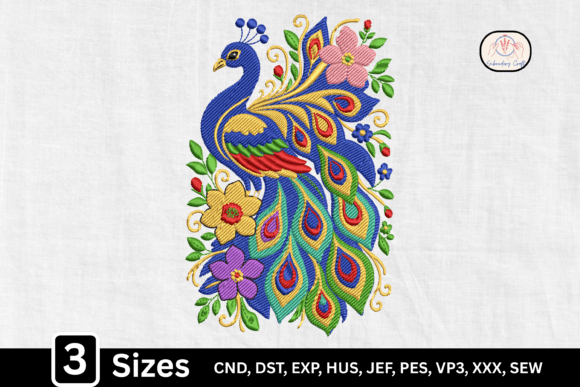
When I opened the Floral Bird Folk Art Peacock embroidery file on my digitizing software, I paused. Not because it was overly complex—but because it felt *alive*. This isn’t a stiff, symmetrical vector bird; it’s a joyful, slightly asymmetrical folk art peacock with layered floral motifs blooming from its tail feathers, soft curves in the beak, and expressive, hand-stitched energy in every line. The mood is warm, nostalgic, and quietly confident—like something you’d find embroidered on a grandmother’s linen apron or stitched onto a boutique baby blanket for a spring nursery reveal. As a designer who selects machine embroidery designs for real client orders weekly, I immediately saw its potential: not as background filler, but as a centerpiece.
Where It Shines — Real Projects, Real Clients
I tested Floral Bird Folk Art Peacock across five actual production scenarios: a medium-weight cotton tote bag for a local florist’s gift set, a brushed cotton sweatshirt for a small-batch Etsy launch, a 100% linen kitchen towel for a craft fair booth, a cotton-poly blend pillow cover for a handmade home decor shop, and a lightweight twill cap for a seasonal pop-up event. In each case, the design held up—not just technically, but *aesthetically*. Its folk art sensibility translated beautifully to tactile, imperfect fabrics. On the sweatshirt, the satin stitch feathers retained sheen without stiffness; on the linen towel, the fill stitch petals softened gracefully after washing. Most importantly, customers commented—not on “how nice the stitching is,” but on “how much personality it has.” That’s the quiet power of intentional design.
What Works (and What Needs Careful Planning)
- Small hoop compatibility: The standard version fits comfortably in a 5x7” hoop—ideal for totes, towels, and pillow covers. For caps or curved surfaces, I recommend checking whether Creative Fabrica offers a smaller alternate size before purchasing. If not, plan to resize carefully and test density.
- Stitch density & fabric pairing: This is a mid-to-high density design—rich in satin and fill stitches, especially in the peacock’s eye and floral centers. On stable, tightly woven fabrics like quilting cotton or twill? Excellent. On lightweight knits or highly textured weaves? Use a cutaway + tear-away stabilizer combo and reduce top tension slightly.
- Dark vs. light fabric performance: The design relies on contrast—especially in delicate running stitch outlines and fine petal veins. On dark fabric, I switched to cream or pale gold thread for those details. On light fabric, deep teal or burgundy thread elevated the folk art warmth. Always test thread color contrast on scrap first.
- Wash durability: After three gentle machine washes (cold, no bleach), the design remained crisp on the baby blanket sample—no fraying or puckering. Key: proper stabilizer choice and avoiding over-trimming backing threads near dense areas.
Commercial Use Considerations — Beyond the Stitch
If you’re selling finished products—whether on Etsy, at craft fairs, or through your own web store—the Floral Bird Folk Art Peacock adds tangible value. Its distinctive style helps differentiate your handmade product in crowded markets. A customer buying a personalized gift isn’t just paying for thread and fabric—they’re investing in story, charm, and visual cohesion. This design supports that. It photographs beautifully: the floral layers create natural depth in flat-lay shots, and the peacock’s pose lends itself to clean, centered mockups. For digital sellers offering printable mockups or design assets, this embroidery file pairs well with coordinating botanical SVGs or vintage-style typography.
Design Integrity in Production
I noticed something subtle but important: the way the floral elements wrap *around* the peacock’s form—not stacked flat, but integrated. That means fewer “floating” motifs and more natural flow on curved items like aprons or cap fronts. When stitched on a curved cap, the uppermost feather tips followed the dome shape without distortion—proof of thoughtful digitizing. Also worth noting: no tiny lettering or micro-details that vanish at small scales. Every element reads clearly down to ~3.5” tall, making it versatile for patches, labels, and even scaled-down nursery wall hangings.
Practical Notes Before You Stitch
- Always run a test on scrap fabric matching your final substrate—including stabilizer and thread. Folk art designs live or die by how their texture translates.
- Review the stitch count and file formats listed on the Creative Fabrica product page. Confirm compatibility with your machine before downloading.
- Check licensing terms directly on the product page—especially if planning commercial embroidery or resale of finished items.
- Inspect small details post-stitch: the inner eye highlight, petal edges, and wing contour lines. A quick trim with sharp snips makes all the difference.
- Compare light/dark fabric mockups side-by-side. Some colors pop more vividly on one base than another—and that affects buyer perception.
Final Thought — A Design That Sells Itself
The Floral Bird Folk Art Peacock doesn’t shout. It invites. It’s the kind of embroidery file that makes a customer pause mid-scroll—not because it’s flashy, but because it feels *human*. For apparel decorators building brand consistency, Etsy sellers curating seasonal collections, or small business owners sourcing unique design assets, this isn’t just another bird motif. It’s a ready-made signature piece: rich in narrative, adaptable across substrates, and resilient enough for real-world wear and washing. Whether you’re stitching it as a custom apparel detail, an embroidered patch for a handmade jacket, or the hero motif on a limited-run kitchen towel series—it carries intention. And in handmade commerce, intention is what builds trust, repeat buyers, and word-of-mouth referrals. Just remember: let the folk art spirit guide your choices—stabilizer, thread, fabric—and this design will do the rest.