Ottoman Tulip Embroidery Design
First Impressions: Regal, Refined, and Richly Textured
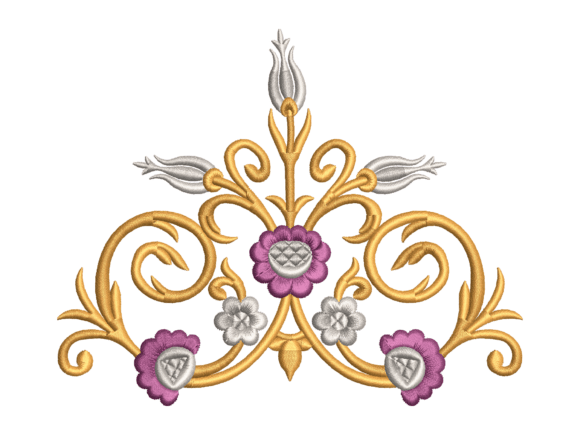
As an embroidery designer who’s stitched for boutique brands from Brooklyn to Bali, my first glance at the Ottoman Tulip Embroidery Design stopped me mid-thread-cut. That title alone—“Royal Baroque Floral Filigree”—sets an immediate tone: not just floral, but architectural floral. Not merely decorative, but ceremonial. This isn’t a dainty daisy chain—it’s a controlled cascade of tulips wrapped in swirling scrolls, delicate tendrils, and ornamental symmetry reminiscent of 17th-century Ottoman court textiles. The mood is quietly confident: elegant without being stiff, ornate without feeling cluttered. Layout feels balanced for chest placement—centered yet dynamic, with vertical rhythm that draws the eye upward, perfect for framing a neckline or anchoring a hoodie front.
Sweatshirt Realities: How It Performs on Real Fabric
I tested this machine embroidery design virtually—and mentally—across five real-world sweatshirt scenarios common to small shop product development:
- Neutral heather gray crewnecks: The filigree pops with subtle contrast. Light thread on medium fabric reads as artisanal, not loud—ideal for customers who value “quiet luxury.”
- Deep charcoal or navy hoodies: Here, the Ottoman Tulip Embroidery Design transforms into a tactile focal point. Dark fabric makes every loop and satin-stitched petal feel intentional and dimensional—no risk of visual flattening.
- Pastel blush or oat milk sweatshirts: Soft backgrounds let the regal sophistication shine without competing. The design reads feminine and refined—not saccharine, not clinical—just thoughtfully harmonious.
- Oversized hoodies (especially with dropped shoulders): Its vertical emphasis works beautifully on the upper chest, avoiding awkward stretching across seams or sagging near the pocket. No distortion, even on relaxed fits.
- Seasonal cozy layers (tweed-blend fleeces, brushed cotton blends): The Baroque detail holds up against textured surfaces because it’s built on strong negative space and clear line hierarchy—not tiny filler stitches that disappear in nap.
Design Personality: Where Elegance Meets Wearability
This isn’t a “cute” or “playful” hoodie design. It’s not minimal. It’s not rustic or grunge. It’s decorative—yes—but with intention, restraint, and historical resonance. For a boutique brand, that means instant visual recognition: customers scrolling Instagram or Etsy will pause not because it’s loud, but because it feels *considered*. It signals craftsmanship before a single stitch is sewn. On a handmade product, it elevates perceived value—not by adding bling, but by whispering heritage, patience, and precision. That quiet authority builds buyer trust faster than any tagline.
Practical Designer Notes: What You’ll Actually Need to Know
Before ordering your digital embroidery file, here’s what I’d verify as a working embroiderer:
- Thread color contrast: Royal Baroque implies rich jewel tones—deep sapphire, emerald, or burgundy threads will sing against light fabric; metallic gold or silver accents would elevate it further on darks. But avoid low-contrast combos (e.g., light ecru on oat milk)—filigree needs breathing room.
- Stitch density & fabric thickness: Baroque filigree can easily become dense. Confirm the stitch density stays under 12,000–14,000 stitches for a standard 4″–5″ chest placement. Too dense = puckering on soft fleece; too sparse = loss of definition. A medium-weight cutaway stabilizer is non-negotiable for clean results on knits.
- Hoop size & placement flexibility: Does the Ottoman Tulip Embroidery Design fit comfortably in a 5×7 hoop? Can it scale cleanly to 3.8″ (for petite sleeves) or expand to 6.2″ (for back panels) without losing line integrity? Ask your vendor—scaling ornate vector-based filigree poorly turns elegance into fuzz.
- Small-size readability: At 3″ wide, do the inner scrolls still read as intentional curves—or just blobs? Test the smallest intended use case (e.g., sleeve cuff accent) before committing.
- Washing durability: Tight satin fill + fine outlines hold up well—if digitized with proper underlay and lock stitches. But confirm the embroidery file includes jump stitch optimization for commercial embroidery machines. No one wants loose threads after three washes.
Beyond the Stitch: Brand & Business Impact
For an Etsy seller or small apparel decorator, the Ottoman Tulip Embroidery Design isn’t just decoration—it’s a brand amplifier. Used consistently across sweatshirts, tote bags, and even pillow covers (yes—Bedroom crossover works), it creates cohesive design assets that tell a story: heritage-inspired, hand-curated, quietly luxurious. In lifestyle product photography, it catches light beautifully—those filigree loops create natural highlights, making mockup previews pop without heavy editing. On an Etsy listing, it justifies premium pricing: customers pay for the feeling of owning something timeless, not trend-driven. And because it’s rooted in historical textile language—not fast-fashion motifs—it sidesteps obsolescence. That longevity directly supports sustainable branding for small shop owners.
A Final Note for Creative Entrepreneurs
If you’re sourcing this embroidery file for custom apparel, treat it like a collaborator—not just a graphic. Let its Baroque rhythm inform your color palette, your packaging foil stamp, your Instagram grid spacing. Pair it with serif typography, linen tags, and matte black hangers. Because the Ottoman Tulip Embroidery Design doesn’t just sit on fabric—it invites curation. It asks you to slow down, choose well, and present with care. That’s how small brands build loyalty: not with volume, but with vision. Before production, always confirm file format compatibility, recommended hoop size, and commercial license terms—especially if scaling beyond personal use. When executed right, this isn’t embroidery. It’s heirloom energy, stitched into now.